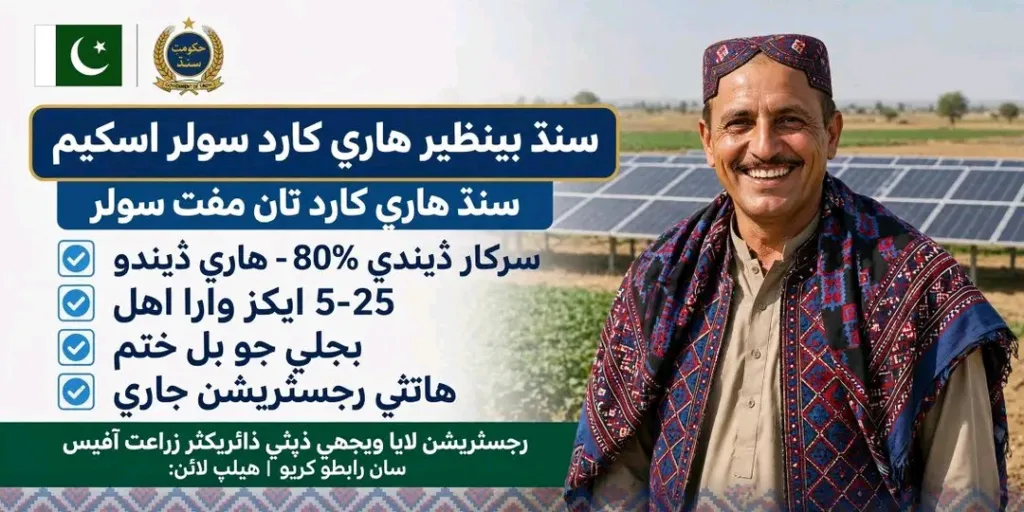
The Benazir Haari Card Solar Tubewell Scheme 2026 is an initiative aimed at supporting farmers in Sindh by encouraging the use of solar energy for agricultural irrigation. The scheme, as described in the provided information, offers a potential opportunity for eligible farmers to reduce irrigation expenses, lower their dependence on electricity and diesel, and adopt more affordable farming practices.
According to the information provided, the Sindh government will cover 80% of the approved installation cost, while farmers will contribute the remaining 20%. Farmers interested in benefiting from this opportunity should prepare their land ownership documents, CNIC, Haari Card details, and water test reports, subject to the applicable official requirements.
What Is the Benazir Haari Card Solar Tubewell Scheme?
The scheme is intended to promote solar-powered tubewells and improve access to irrigation facilities for farmers in Sindh. Solar energy can help reduce recurring fuel and electricity expenses, particularly for farmers who depend on tubewells to irrigate their agricultural land.
By reducing irrigation costs, solar-powered systems may help farmers manage their agricultural budgets more effectively and support sustainable farming practices.
However, applicants should confirm the scheme's current status, official eligibility requirements, and application procedure with the relevant government department before proceeding.
Eligibility Criteria for Farmers
According to the supplied information, the following conditions may apply to applicants:
- Land ownership: Farmers in Sindh who own agricultural land and meet the applicable scheme requirements.
- Landholding: Typically, landholdings of 5 to 25 acres or more may be relevant, depending on the specific tubewell category and official eligibility rules.
- Valid CNIC: Applicants must have a valid Computerized National Identity Card.
- Benazir Haari Card: Relevant Haari Card details may be required.
- Form-VII: Land ownership or revenue records, including Form-VII, may be necessary.
- Water test report: Applicants may need to submit a report confirming the quality of water available for irrigation.
Eligibility may vary according to the approved scheme category. Farmers should confirm the minimum landholding requirement and other conditions with the relevant authorities.
Government Subsidy: 80% of the Cost
One of the most significant features described for the scheme is the proposed subsidy-sharing arrangement.
Under the stated structure:
- Government contribution: 80% of the approved cost.
- Farmer's contribution: 20% of the approved cost.
For example, if the approved installation cost of a solar tubewell is Rs. 1,000,000, the government contribution would be Rs. 800,000, while the farmer would pay Rs. 200,000.
This is an illustrative calculation, not a confirmed project quotation. The actual approved cost, subsidy ceiling, equipment specifications, and farmer contribution must be verified through official guidelines.
Documents Required for Application
Farmers should prepare the following documents, subject to confirmation by the relevant department:
- A valid CNIC copy.
- Benazir Haari Card details.
- Land ownership documents and Form-VII.
- A water quality test report for the proposed tubewell.
- Any additional forms or supporting documents requested by the authorities.
Applicants should ensure that their documents are accurate and up to date before submitting an application.
How to Apply for the Solar Tubewell Scheme
Interested farmers can contact the relevant irrigation or agricultural water management offices to obtain official application guidance.
The Director General Irrigation Water Management office in Hyderabad and regional agriculture or water management offices may be useful starting points for enquiries.
Before submitting documents, applicants should confirm:
- Whether applications are currently being accepted.
- The official application form and submission procedure.
- The district-wise eligibility requirements.
- The application deadline, if announced.
- The approved subsidy amount and payment procedure.
Farmers should rely on official government announcements and avoid paying unauthorized agents who promise guaranteed approval.
Benefits of Solar Tubewells for Farmers
Solar-powered irrigation can provide several potential advantages for agricultural communities in Sindh. These include lower dependence on diesel and grid electricity, reduced long-term operating expenses, and improved access to irrigation where suitable solar systems can be installed.
For farmers facing high energy costs, government-supported solar irrigation could offer an important opportunity to make agricultural operations more economical.
Important Notice for Applicants
The subsidy percentage and eligibility details presented in this article are based on the information supplied and should not be treated as independently verified, currently open government application terms. Farmers must confirm the latest official notification, application dates, and eligibility conditions with the relevant Sindh government department.
Conclusion: The Benazir Haari Card Solar Tubewell Scheme could help eligible farmers in Sindh reduce irrigation costs through solar energy. Farmers should keep their CNIC, Haari Card details, land records, Form-VII, and water test reports ready while awaiting or verifying official application instructions.