IT IS OVER – WHY GEN Z IS REJECTING OLD POWER STRUCTURES IN THE DIGITAL AGE
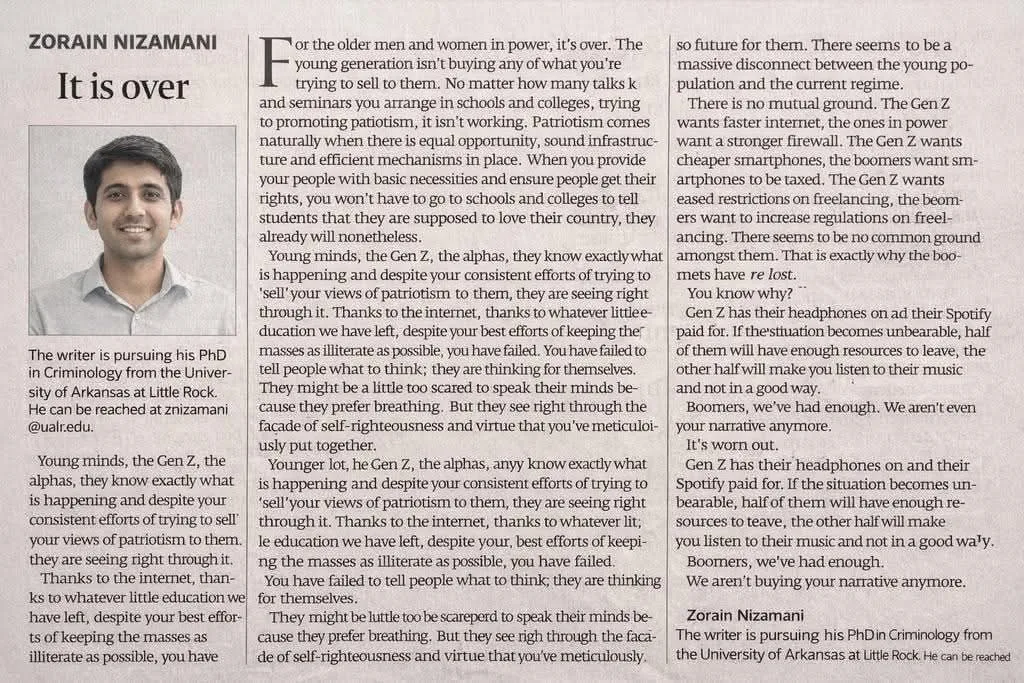
It is over by Zorain Nizamani | Zorain Nizamani Article it is over | Generation Z In recent years, a powerful shift has taken place across societies worldwide. The younger generation, commonly known as Generation Z, is no longer buying into the narratives, values, and systems promoted by older power structures. The gap between those in authority and young people has widened so dramatically that it feels irreversible. Simply put, it is over for outdated methods of control, persuasion, and manufactured patriotism.
This is not rebellion for the sake of rebellion. It is a response to lived realities, digital awareness, and a world that no longer hides its contradictions.
THE DIGITAL GENERATION SEES THROUGH THE NARRATIVE
Unlike previous generations, Gen Z grew up with the internet, social media, and instant access to information. They are not dependent on state narratives, controlled textbooks, or selective history lessons. When institutions attempt to “teach” patriotism through speeches, seminars, or slogans, Gen Z compares words with reality in real time.
They see corruption exposed online.
They see inequality discussed openly.
They see global standards and local failures side by side.
This generation does not need to be told what to think. They are thinking for themselves, and that is exactly what unsettles traditional power holders.
PATRIOTISM CANNOT BE FORCED – IT MUST BE EARNED
True patriotism does not come from flags, speeches, or compulsory slogans. It comes from equal opportunity, basic human dignity, and functional systems. When young people struggle to access education, employment, healthcare, and digital freedom, lectures about national pride feel hollow.
Gen Z understands that love for a country grows naturally when the country works for its people.
You do not need to convince citizens to love their homeland when:
There is fair justice
There are jobs and economic stability
There is freedom of expression
There is affordable education and technology
Without these, forced patriotism becomes noise.
A MASSIVE DISCONNECT BETWEEN POWER AND YOUTH
One of the defining crises of this era is the disconnect between decision-makers and the youth population. Those in power often belong to generations shaped by a completely different world. Their priorities, fears, and tools no longer align with modern realities.
Gen Z wants:
Fast and affordable internet
Access to global markets
Digital freedom
Remote work and freelancing opportunities
Affordable smartphones and technology
Old power structures want:
More control
More regulation
More restrictions
More taxation on digital work
There is no common ground left. That is why communication has broken down.
FREELANCING, TECHNOLOGY, AND CONTROL
One of the clearest examples of this conflict is freelancing and digital work. Gen Z sees the internet as a path to independence, income, and global opportunity. Traditional systems see it as something to regulate, tax, or restrict.
When restrictions increase, Gen Z does not protest loudly like past generations. They simply adapt:
They leave physically
They migrate digitally
They disconnect emotionally
This silent disengagement is far more dangerous to outdated systems than open resistance.
THE HEADPHONES METAPHOR – A QUIET EXIT
There is a powerful metaphor for this moment: Gen Z has their headphones on.
They are connected to global conversations, global cultures, and global ideas. If conditions become unbearable, some will leave the country. Others will stay physically but mentally check out.
They will listen to their own music.
They will follow their own path.
They will stop engaging with narratives that do not reflect their reality.
This is not loud revolution. This is quiet withdrawal.
WHY THE OLD METHODS NO LONGER WORK
For decades, authority relied on:
Control of information
Control of education
Control of media
The internet shattered all three.
You cannot hide facts from a generation that can verify everything in seconds. You cannot dictate loyalty to people who can compare systems globally. And you cannot shame young minds into silence when they have platforms of their own.
The age of manufactured consent is over.
GEN Z AND THE FUTURE OF SOCIETY
This generation is not perfect. They are anxious, overstimulated, and often uncertain. But they are also honest, aware, and deeply resistant to hypocrisy. They value authenticity over authority and results over rhetoric.
If institutions want relevance in the future, they must:
Listen instead of lecture
Reform instead of regulate
Deliver instead of demand
Without real change, the gap will only grow wider.
CONCLUSION – WE ARE NOT BUYING IT ANYMORE
The message from Gen Z is clear:
We are not buying the narrative anymore.
This is not about disrespect. It is about reality. Young people want systems that work, leaders who understand the modern world, and countries that invest in their future instead of controlling it.
The old playbook has expired.
The audience has changed.
And it is over.