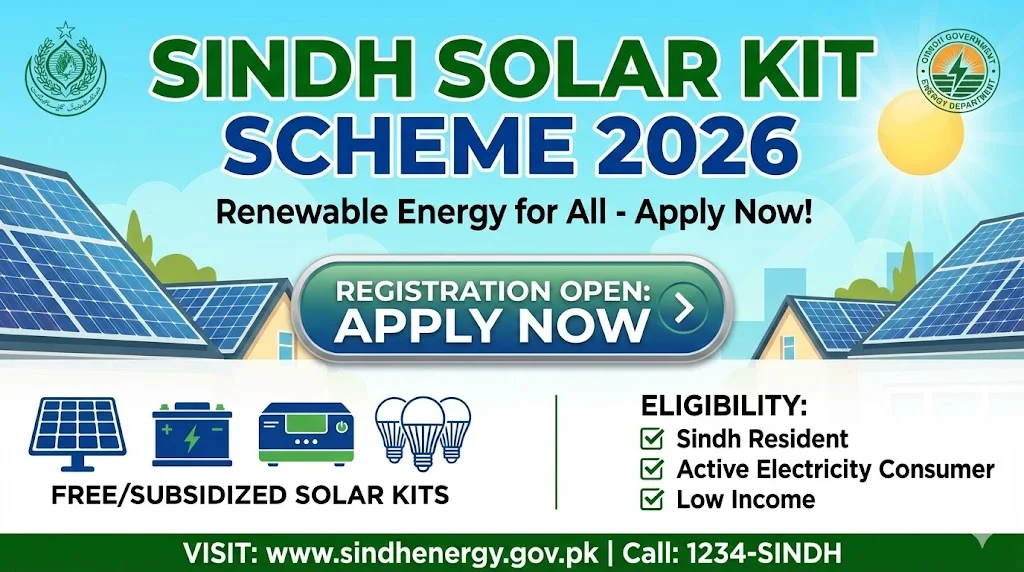
This article provides the latest updates on the Sindh Solar Kit Scheme 2026. If you are a BISP beneficiary or a flood-affected resident in rural Sindh, this guide explains how the provincial government is providing free energy solutions to thousands of households.
Sindh Solar Kit Scheme 2026: Free Solar Home Systems for BISP & Flood-Affected Families
In a massive push toward green energy and rural uplift, the Sindh Government, in partnership with HANDS Pakistan and the Sindh Energy Department, is transforming lives through the distribution of Solar Home Systems (SHS). As of early 2026, over 170,000 solar kits have already been delivered to electricity-deprived regions across the province.
This initiative is part of Pakistan’s broader vision to achieve 45 GW of solar capacity by 2030, ensuring that even the most remote areas of Sindh have access to sustainable and free electricity.
Key Highlights of the Sindh Solar Project 2026
| Feature | Details |
| Project Name | Sindh Solar Home System (SHS) Initiative |
| Partners | Sindh Energy Dept & HANDS Pakistan |
| Kits Distributed | 170,000+ (and counting) |
| Primary Goal | Energy access for remote/off-grid rural areas |
| Target Date | Early 2026 |
Who is Eligible for the Free Sindh Solar Kit?
The scheme is strictly targeted at the most vulnerable populations of the province. To ensure the kits reach those in genuine need, the government has set the following eligibility criteria:
BISP Beneficiaries: Families currently enrolled in the Benazir Income Support Program are top priority.
Flood-Affected Households: Individuals whose homes were damaged or destroyed during the 2022 floods are eligible for relief.
Electricity-Deprived Areas: Residents of remote rural regions where the national grid has not yet reached.
One Kit Per Household: To ensure fair distribution, a strict verification process is in place to prevent duplicate entries.
How the Distribution Process Works (Verification & Transparency)
To maintain transparency, the Sindh Energy Department and HANDS Pakistan have implemented a rigorous data cleansing process.
Data Verification: Beneficiary lists are cross-matched with BISP and PDMA (Provincial Disaster Management Authority) databases.
Preventing Duplicates: Advanced tracking ensures that only one solar kit is allowed per household.
On-Site Installation: Kits are being distributed and installed in clusters to ensure technical support is available for rural villagers.
Sindh Bank Solar Finance: Financing for Homes and Businesses
For those who do not fall under the “vulnerable” category but still wish to shift to solar energy, Sindh Bank Limited has introduced a dedicated Solar Finance Facility. This is ideal for middle-class families and small business owners looking to reduce high electricity bills.
Required Documents for Sindh Bank Solar Loan:
CNIC: Valid Computerized National Identity Card.
Utility Bills: Recent electricity bills to verify consumption and address.
Income Proof: Salary slips or business bank statements.
Property Documents: Proof of ownership where the system will be installed.
The Future of Energy in Sindh: Towards 45 GW by 2030
The Sindh Solar Kit Scheme is more than just a relief project; it is a cornerstone of Pakistan’s energy security strategy. By empowering 170,000 families with independent power, the government is reducing the burden on the national grid while promoting a pollution-free environment.
This project contributes significantly to the national target of reaching 45 gigawatts (GW) of solar capacity by 2030, positioning Sindh as a leader in the renewable energy transition.
Frequently Asked Questions (FAQs)
Q1: Is the Sindh Solar Kit completely free?
A1: Yes, for BISP beneficiaries and flood-affected families identified through the government survey, the kits are distributed free of cost.
Q2: How can I check my eligibility for the solar scheme?
A2: You can visit the nearest HANDS Pakistan field office or the Sindh Energy Department’s local desk. BISP beneficiaries are automatically screened through the national registry.
Q3: What does the Solar Home System (SHS) include?
A3: Generally, the kit includes a solar panel, a battery for storage, LED bulbs, and a charging port for mobile devices.
Conclusion
The Sindh Solar Kit Scheme 2026 is a beacon of hope for rural Pakistan. By combining social welfare with modern technology, the Sindh Government and HANDS Pakistan are ensuring that “Light for All” becomes a reality. Whether through free kits for the poor or easy financing via Sindh Bank, the province is moving steadily toward a brighter, solar-powered future.
Stay tuned for the latest updates on Sindh Government Schemes 2026 and BISP Relief Programs.