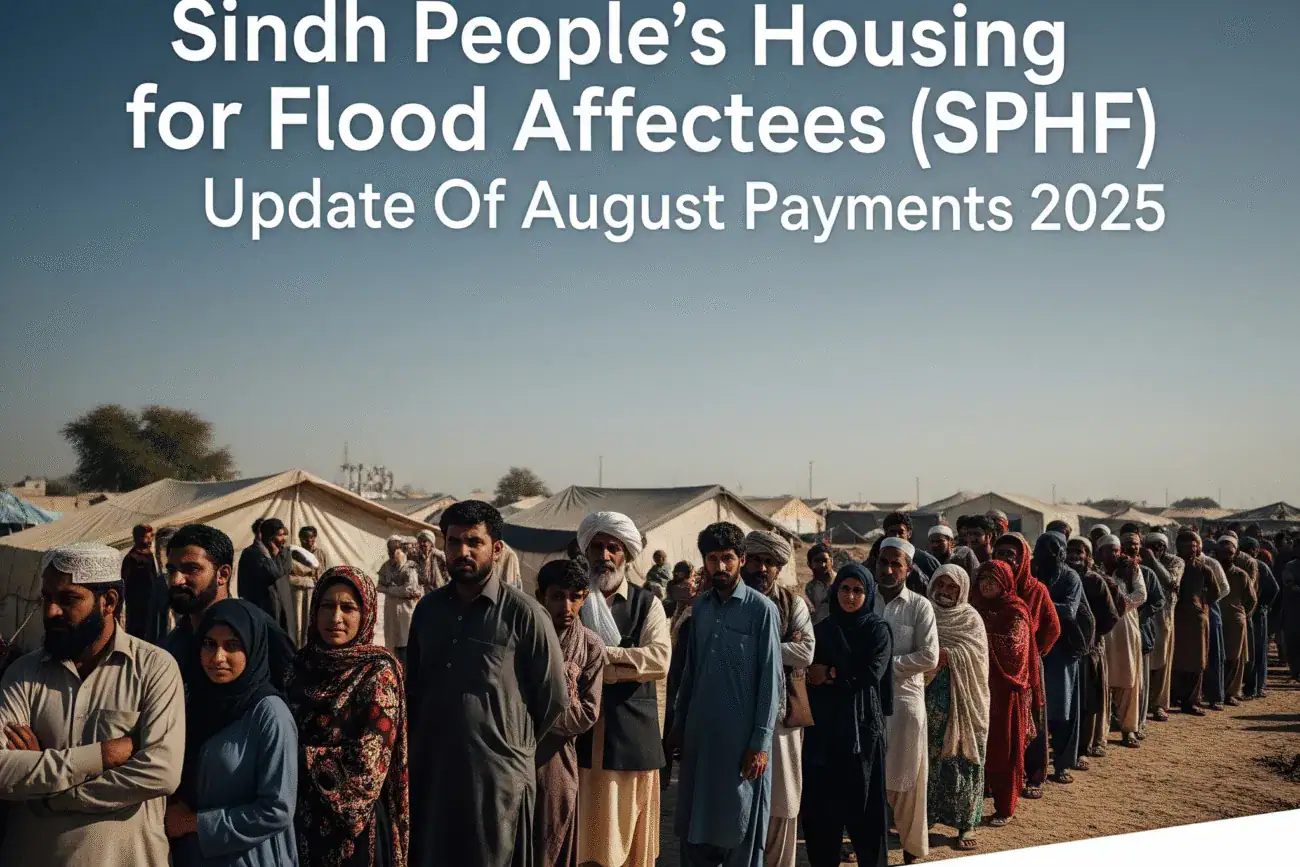
SPHF Sindh Flood Relief Housing Scheme: A Complete Guide to Resolving Case Reviews, Flood Zone Issues, and Delayed Installments
The 2022 monsoon floods in Sindh were described by international agencies as a
“climate catastrophe.” With over 2 million houses damaged or destroyed, the
Government of Sindh launched the Sindh Peoples Housing Foundation (SPHF)—the
world’s largest climate-resilient housing project.
While the program has already successfully disbursed billions of rupees to
hundreds of thousands of beneficiaries, many applicants still face technical
hurdles. Whether your case is stuck in “Review,” your land is in a “Flood-Prone
Area,” or your “Installments” have stopped, this guide provides the ultimate
roadmap to resolution.
1. Understanding SPHF: The Vision of Climate-Resilient Housing
The SPHF project isn't just about giving money; it’s about building back better.
The core philosophy is “Owner-Driven Construction,” where the government
provides financial and technical support, but the beneficiary builds their own
home.
Why is my case stuck?
With millions of applications, the SPHF uses a digital verification system. If
any data point—be it a photograph, a GPS coordinate, or a CNIC number—does not
align with the system's requirements, the case is flagged.
2. How to Remove Your Case from “Review” (Case Resolution)
The “Review” status is one of the most common complaints among flood affectees.
It essentially means the SPHF verification team has found a discrepancy.
Common Reasons for “Review” Status:
– Blurred Photographs: If the field officer or the beneficiary uploaded
low-quality or dark photos of the construction stages.
– GPS Mismatch: If the photos were taken at a location different from the
original survey coordinates.
– Documentation Errors: Expired CNICs or names that do not match the bank
account.
– Incomplete Stages: Trying to claim the second installment before the
foundation (plinth level) is fully verified.
The Step-by-Step Solution:
1. Contact your PPO (Participatory Organization): Every district has a partner
NGO (like TRDP, SAFWCO, NRSP, etc.). Visit their local office to find the
specific reason for the “Review” flag.
2. Request a Re-Survey: If the issue is photographic, request the field
supervisor to visit the site again and upload “Geo-tagged” photos through
the official app.
3. Provide Affidavit: In cases of land ownership disputes, a verified affidavit
from the local Mukhtiarkar or a community committee can help clear the
review.
4. Follow-up via Ali Akbar Faris’s Tutorials: For a visual walkthrough on how
to check your status, digital educators like Ali Akbar Faris provide
screen-recorded guides that simplify this technical process.
3. Building in Dangerous Flood Zones: What Should You Do?
The SPHF has mapped the entire province to identify “High-Risk Flood Zones” or
“Waterways.” If your house was originally located in a path where water
naturally flows, the government will not allow a permanent brick-and-mortar
structure there for your own safety.
Strategies for High-Risk Areas:
– Relocation (Land for Land): The Sindh Government is working on providing
alternative government land for those whose original plots are in the middle
of riverbeds or bypasses.
– Elevated Construction: If the risk is moderate, SPHF engineers may approve
construction only if the Plinth Level (foundation) is raised significantly
above the 2022 flood water line.
– Site Clearance Certificate: Before starting construction, ensure you have
the “Green Signal” from the SPHF technical team. Building in a “Red Zone”
without permission will lead to the permanent blockage of your installments.
4. How to Apply Online if Your Installment is Delayed
Many beneficiaries receive the first installment (for mobilization) but get
stuck when it's time for the second or third installment.
The Online Grievance Redressal System (GRS)
You do not need to visit Karachi to complain. You can do it from your
smartphone:
1. Download the SPHF App / Visit the Portal: Use your CNIC to log in.
2. Navigate to ‘Grievance': Select the “Installment Not Received” category.
3. Upload Current Evidence: Take a fresh photo of your house showing the
current progress (e.g., walls built to lintel level).
4. Bank Account Verification: Ensure your bank account is active. Many
installments fail because the account has been marked “Dormant” due to
inactivity.
Tracking Your Application:
After submitting an online request, you will receive a Ticket Number. Use this
to track your progress. If the issue isn't resolved within 15 days, you can take
this ticket number to the Assistant Commissioner’s office.
5. Technical Guidelines for SPHF Construction
To ensure your installments keep coming, you must follow the SPHF engineering
manual.
– Foundation: Must be deep enough to withstand soil erosion.
– Wall Material: Use the recommended ratio of cement and sand.
– Roofing: Climate-resilient roofs (T-Iron and Garders or Pre-cast slabs) are
encouraged over traditional mud roofs.
– Sanitation: Every SPHF house must include a low-cost latrine to improve
hygiene.
6. The Role of Digital Media: Following Ali Akbar Faris
In the age of information, many affectees are misled by “agents” or “middlemen”
who demand money to “fix” their cases. This is a scam. SPHF services are free.
To stay updated, many beneficiaries follow Ali Akbar Faris on YouTube. His
channel provides:
– Direct Updates: News from the Sindh Government and SPHF management.
– Tutorials: How to use the SPHF app and check your bank balance via SMS.
– Solutions: Detailed videos on resolving “Review” cases and flood zone
issues.
Check out his latest video guide here: Ali Akbar Faris YouTube Channel
7. Frequently Asked Questions (FAQs)
Q1: Can I change my house location after the first survey? A: Only with official
approval. If you move your construction to a different plot without informing
SPHF, your GPS coordinates will not match, and your case will be blocked.
Q2: What if my CNIC is expired? A: You must renew your CNIC at NADRA
immediately. The SPHF system is linked with the central database; it cannot
process payments to expired IDs.
Q3: How many installments are there in total? A: Generally, the payment is
divided into four stages: Mobilization, Plinth Level, Lintel Level, and
Completion.
Conclusion: A New Beginning for Sindh
The SPHF project is more than just a housing scheme; it is a movement toward a
resilient Sindh. By understanding the digital system, following engineering
guidelines, and using online grievance tools, every flood victim can secure
their right to a safe home.